
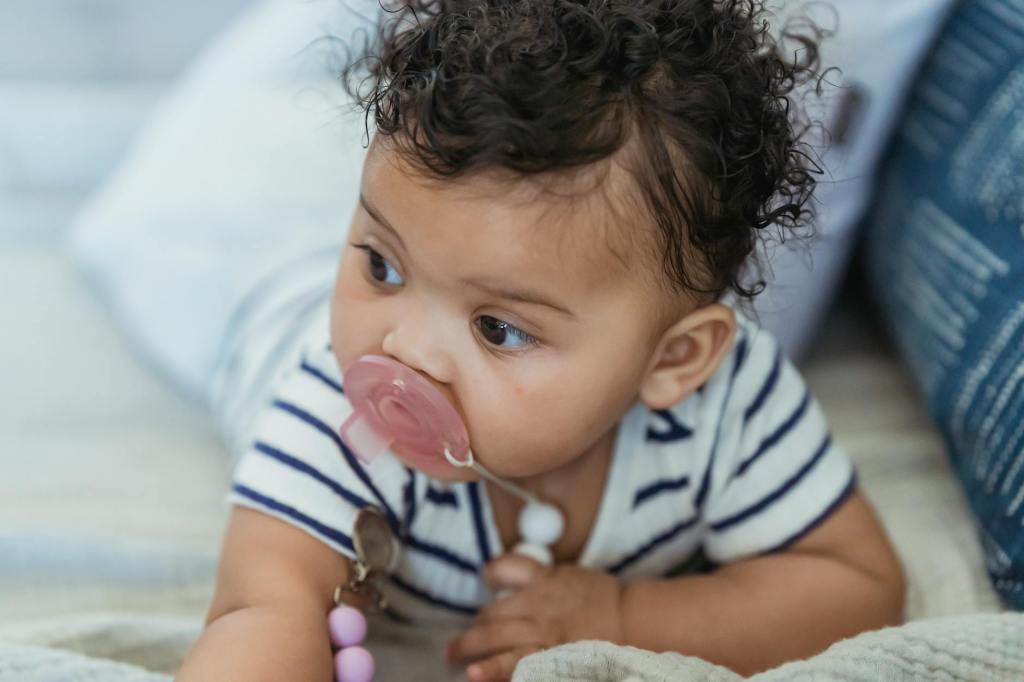
Parents frequently ask me: what’s the scoop on pacifiers? Is it okay to use them, or are they causing more harm than good?
The black-and-white takes on pacifiers tend to land in two camps:
- don’t use a pacifier at all if you want to breastfeed; it’ll derail your journey
- pacifiers are fine and have no impact on feeding
My response is, as with most things, full of nuance. 🙂
The extent to which a pacifier is helpful depends significantly on how we choose to use it!
Overall, pacifiers used thoughtfully can be overall helpful for families, can reduce crying (and protect parental mental health!), and will not interfere with breastfeeding. By prioritizing active use over passive use and choosing an optimal shape, you can incorporate pacifiers without stressing about negative impacts.
Active Pacifier Use
Active pacifier use is when you are actively using a pacifier to soothe your baby while holding or wearing them – helping baby to actively suckle in order to calm their belly or minimize reflux after a feeding, or to help settle them into sleep.
Active pacifier use also includes suck rehabilitation exercises to help improve strength & coordination in the tongue. These are sometimes prescribed by IBCLCs and other feeding specialists to improve latch, bottle feeding, and/or in pre- or post-frenectomy exercises.
Active pacifier use is typically limited to 5-15 minutes at a time to achieve a particular goal (soothing, settling, strengthening) and is then removed after the goal is achieved.
Active pacifier use, especially when you use an optimally-shaped pacifier (see below) tends to be net neutral or positive for baby’s oral function & development.
Passive Pacifier Use
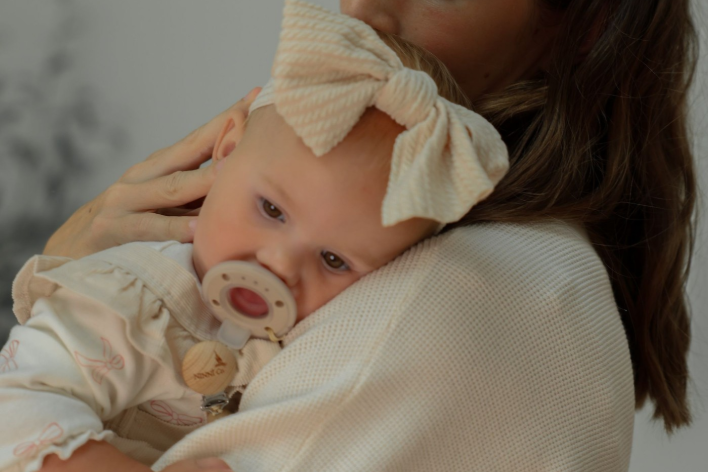
Passive pacifier use is when your baby has a pacifier in their mouth when asleep or while otherwise idle. They may suck in short spurts or hold the pacifier in their mouth without sucking. Prolonged passive use, such as sleeping with a pacifier in throughout the night, can make it difficult for babies to show hunger cues, especially when paired with swaddling or other restrictive sleepwear.
Prolonged use has also been shown to negatively impact dental development, leading to issues such as tooth crowding, high palatal arch, airway issues, poor oral posture, and more (read more here).

Passive pacifier use is particularly important to avoid in the weeks following from a tongue tie procedure, as it can push the tongue down and cause the wound to heal faster & shorter than ideal.
Choosing a Pacifier
The type of pacifier you use also has an impact on baby’s oral motor development.
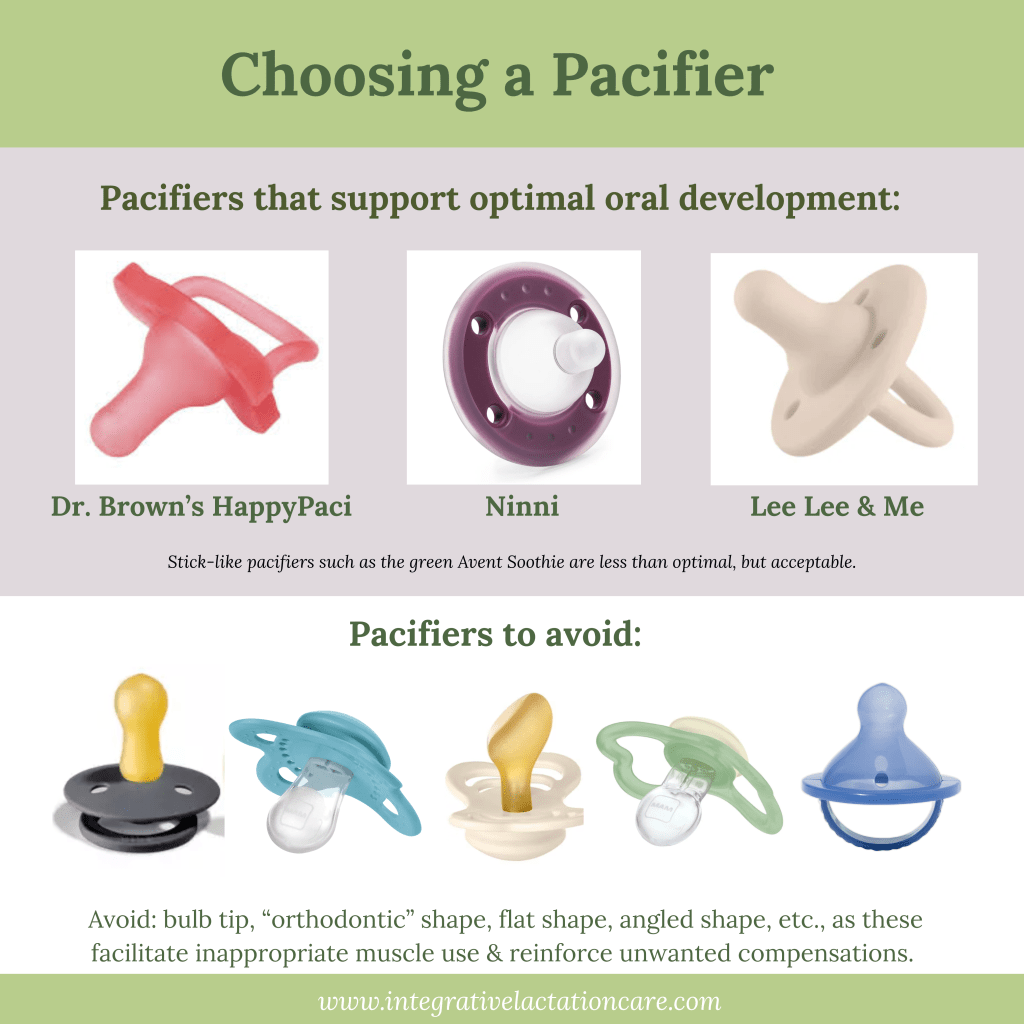
In general, pacifiers with a wide base and a narrow tip tend to promote sucking mechanics more consistent with optimal bottle feeding & nursing. Brands that make pacifiers with this shape include Ninni, Dr. Brown’s (HappyPaci), and Lee Lee & Me.
By contrast, pacifiers with a narrow base and a wide or bulb-shaped tip tend to promote overuse of lip and jaw muscles (not ideal for bottle feeding or nursing), and can push the palate higher over time.
When to Wean?
In general, I encourage parents to wean the pacifier by 6 months since earlier is always easier. By this time, we have usually worked through major feeding & GI issues, and parents have found multiple methods for settling a baby to sleep. This is an ideal time to begin to phase out pacifier usage to protect palate development.
I do find that when parents choose an optimal shape and use pacifiers thoughtfully from the getgo, pacifier use often fades away on its own without much difficulty.
If baby or parent is still heavily dependent on a pacifier for settling after 6 months, it can often be a red flag there may still be feeding or GI issues that need further support.
Final Thoughts
In general, using a pacifier for 10-20 minutes to settle baby or to get through a car ride is perfectly fine.
To maximize pacifier benefits & minimize negative impacts:
- Choose a pacifier supportive of optimal oral function
- Limit use to active settling/soothing (or car rides!) and remove from baby’s mouth once settled or asleep
- Phase out pacifier usage by 6 months
If you need help with getting baby to accept a pacifier OR weaning off of one, please reach out!

 Integrative Lactation Care
Leave a comment