
I remember when I added bottles to my baby registry as an expecting, first-time parent five years ago. There were SO MANY CHOICES (and this was 2019 – there’s even more now) and all of them said the same thing.
“Breast-like”
“Reduces colic”
“Natural flow”
I picked one that was supposedly highly recommended by pediatricians and had “natural” in the name. Solid bet, right?
Oh, how little I knew then…
What Bottle Companies Don’t Want You to Know
The truth is that bottle companies RARELY have feeding professionals on staff, and their products are completely unregulated.
That means those terms on the bottle I mentioned above? They mean absolutely nothing.
There are bottles with wildly different flow rates – some taking an average of THIRTY MINUTES for a 90ml feeding, and others taking LESS THAN THREE MINUTES – both of which call themselves “natural” and “slow flow”. Neither of these are ideal for babies.
Bottle manufacturers will put whatever they want on the bottle to sell their products, and truthfully, they don’t care whether your baby ends up having reflux, gas, etc. If they did, they would actually consult feeding experts, publish objective data about the flow rates on their bottles, and ensure consistency among their products.
Since they don’t, I’m here to help. 🙂
What You Need to Know About Bottles
As an IBCLC, helping families choose a bottle (or bottles) that support optimal feeding is important to me. An optimal bottle matters whether you are mostly nursing and only using occasional bottles, doing a combination of nursing and bottle feeding, or exclusive bottle-feeding (human milk or formula).
Many parents assume that bottle type only matters if you are going back and forth between nursing & bottles, for the sake of preserving the nursing relationship or latching skills. Not true! Bottle type matters for everyone.
So let’s talk about what matters when choosing a bottle.
Nipple Shape
First and foremost, we care about the SHAPE of the bottle nipple. The shape of the bottle itself matters less. Most babies do best with a wide, sloped nipple – and this helps promote optimal oral function and a deep latch on the bottle.
Some bottles (such as the Pigeon) even have a “latch-on indicator” line to show you what a deep latch should look like on the nipple – basically, how far into the baby’s mouth the nipple should be while feeding.
Bottles often claim to be “breast-like” because we want bottle feeding to mimic nursing as much as reasonably possible. This is true even for exclusively formula-fed babies, because early infant oral function is based in how nursing skills evolved over thousands of years. Bottle feeding uses different muscles & oral mechanics, but the goal is still to make taking a bottle similar in shape, flow, and effort required.
When a bottle has a wide base and a stubby nipple (as pictured below on the right), it may look like a breast at rest, but the silicone cannot stretch to fill the baby’s mouth the way that a breast would. That means that an optimal bottle shape is one that fills the baby’s oral cavity similar to a breast at work.
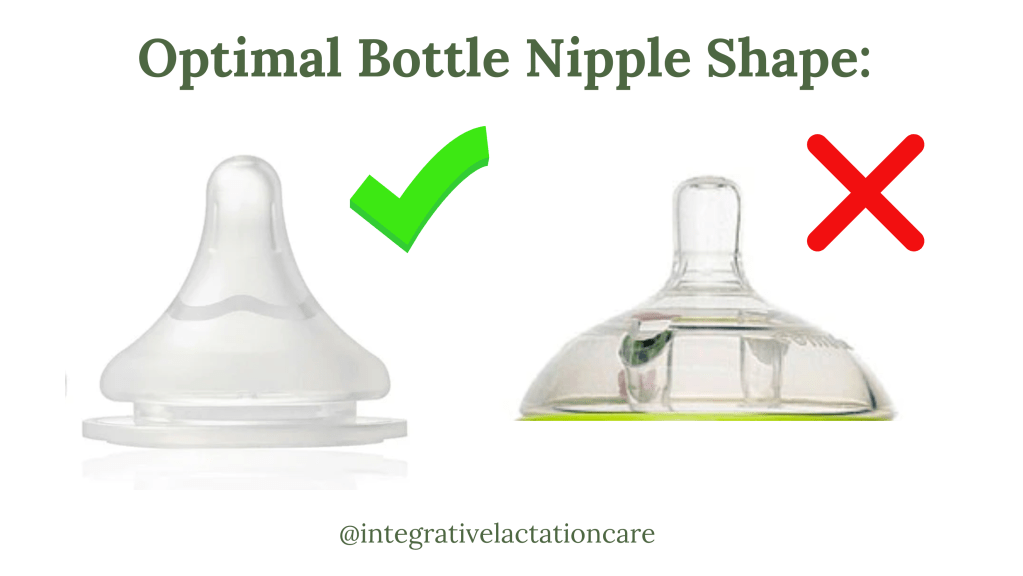
There are a handful of bottle nipples out there that resemble this shape, but before you switch tabs to “Add to Cart”, let’s talk about the second important characteristic: flow rate.
Flow Rate
When I first learned about the differences in flow rates among bottles on the market, I was shocked. As I mentioned above, the numbers range from WAY TOO SLOW to WAY TOO FAST, with very few in the optimal range of true slow flow.
Based on the data I have reviewed, I would estimate that somewhere between 70-90% of bottles on the market today (in the US, anyway) have an inappropriate flow rate. THAT’S WILD.
That means that all of the babies out there with reflux, gas, or other GI issues – might improve either a little or a LOT with something as simple as switching bottles.
The good news for you is that I’ve done my homework about what flow rate is appropriate, and which bottles have that flow rate. If you wish to see the data for yourself, I encourage you to check out Infant Feeding Labs, a third-party research outfit for infant bottles.
In general, we want a bottle to flow at a rate of about 6 ml per minute (~1oz per 5 minutes). This means that most babies should take about 10-15 minutes to finish a ~3oz bottle. Most bottles are way, way faster than this.
It’s also important to note that if you are using an added thickener with your milk or formula, this may change the flow rate.
Bottle Material
Last but not least, we want to consider the material of the bottle itself. Most nipples are based of silicone, which is considered highly safe, free of BPA/PFAS, and resistant to high heat used for heating/sterilizing.
However, most bottles are made of plastic, and in light of the most recent research about microplastics, many families are choosing to avoid plastic in their bottles.
Glass is a safer option that is much more resilient to heat. Most silicone or metal bottles on the market have inappropriate nipple shapes and are not as compatible with ideal nipple shapes. That said, you may be able to find an optimal fit! It should also be noted that flexible silicone can be squeezed while feeding (whereas metal/glass cannot) and doing so inherently changes the flow rate.
Bottles That Don’t Suck:
In short, bottles that I recommend in my practice are (in no particular order – just alphabetical):
Evenflo Balance (Slow) (available in plastic & glass)
Gulicola (Super Slow) (available in glass)
Lansinoh Naturalwave (XS)
Nuk Perfect Match (Slow)
Pigeon (SS) (available in standard plastic, PPSU, & glass)
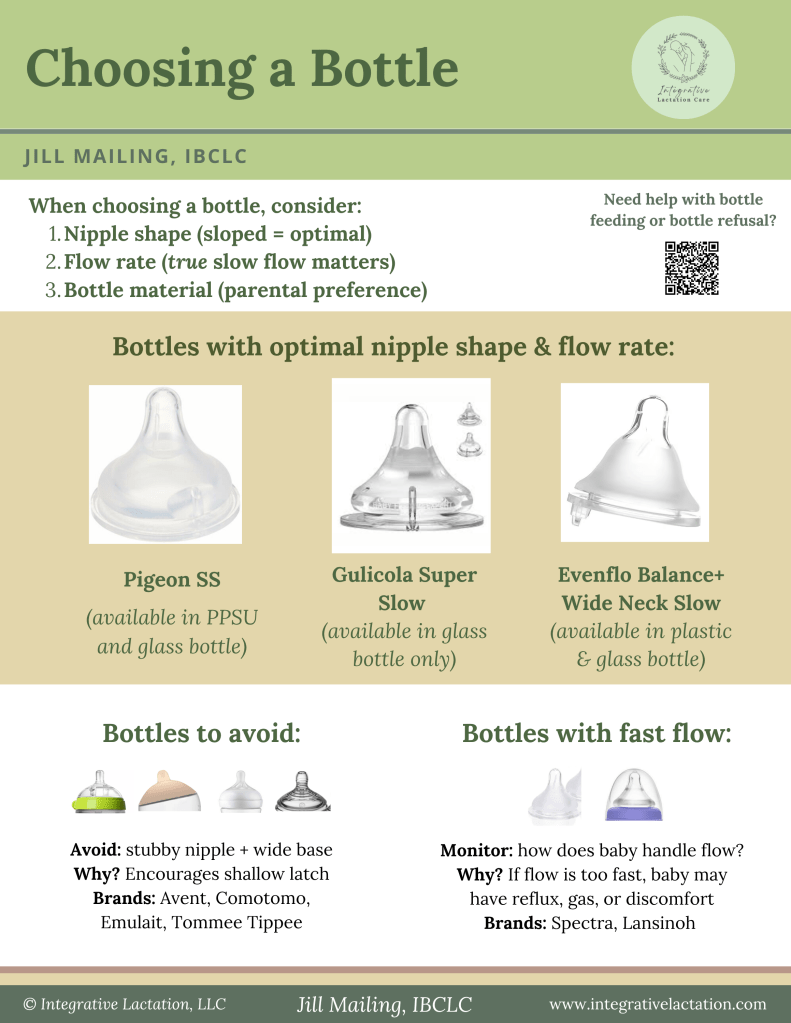
If you have already invested in a bunch of bottles and just want to swap out the nipple, it may be helpful to know that these nipple types ARE compatible with many existing bottles. You can do a quick search to check compatibility.
The LactationHub GentleFlow nipples list their compatibility here.
Note: As an IBCLC, I am not permitted (nor do I wish to) receive any monetary compensation from or offer a formal endorsement of any particular bottle company. The recommendations above are purely based on the fact that they meet the two objective criteria described earlier in the article. There may be other products that meet this criteria – if you happen to find one, please feel free to send it over and I’m happy to consider it for the list.
What About Paced Feeding?
In my opinion, paced feeding is a strategy that evolved and became popular in part because so many bottles are too damn fast.
If you’re using a bottle that has an appropriate shape and flow, paced feeding is still *nice* to do, but it really isn’t as essential. The reality is that paced feeding will help reduce spit-up or gas on a fast-flow nipple, but it isn’t going to resolve it altogether.
I do recommend an elevated side-lying position for bottle feeding (or an upright position for older babies with adequate head control) to help provide postural stability, and especially if you’re nursing, allowing baby to suck on an empty nipple before feeding to mimic the letdown.
Some parents find that taking a break every 1-2oz (especially if baby has shown they benefit from regular burping) is helpful. But if your baby has optimal oral function and is using an optimal bottle, you shouldn’t need to pause the feeding frequently on baby’s behalf – they should be able do it for themselves.
Bottle Feeding Red Flags
Speaking of oral function – it’s worth mentioning red flags that I commonly see with bottle feeding, so that if you switch to an optimal bottle and are still having issues with reflux, gas, or fussiness, it may be helpful to explore other root causes or connect with an IBCLC for a comprehensive feeding evaluation.
Red Flags:
- Clicking noise while bottle feeding
- Leaking milk while feeding
- Gags on bottle nipple
- Shallow latch on the bottle
- Significant spit-up
- Quivering chin/jaw while feeding
- Reflux
- Persistent gas
- Frequent hiccups
- Sucking blisters/peeling lips
- Fussy/cries a lot in between feedings
- Shallow latch on bottle nipple
If your baby will ONLY take the bottles with a wide base and a shallow nipple, there is a very good chance they are sucking with lips only, and there are other factors of oral dysfunction affecting feeding and digestion.
If you are curious about other red flags that may be impacting your baby’s overall well-being, download my red flag screening tool here:

Bottom Line
You and your baby both deserve a seamless bottle feeding experience, and the bottle you choose plays a big part in that experience.
If you want to learn more about optimal bottle feeding, sign up to be notified when my online Better Bottle Feeding course is released (expected January 2026):
If you would like help troubleshooting bottle feeding (including bottle selection, bottle feeding mechanics, pumping, choosing a formula, bottle refusal, etc), I see families in-person in southeast Michigan or virtually from anywhere:

Many thanks to experts Britt Pados, Rachel O’Brien, and Jeanette Mesite Frem, who have provided me with vital education on bottle types, bottle feeding mechanics, and supporting families through bottle feeding challenges! If you are a fellow IBCLC/feeding professional, I highly recommend their resources to expand your knowledge:
Infant Feeding Labs (Britt Pados)
Guiding Bottle Breakthroughs (Rachel O’Brien)
Babies in Common Pumping & Feeding Gear (Jeanette Mesite Frem)

 Integrative Lactation Care
Leave a comment