
Full-spectrum tongue tie care is an approach developed by Integrative Lactation Care to ensure that families whose babies have oral restrictions receive holistic, individualized, & effective treatment from start to finish.
This approach is slow, thoughtful, & methodical.
This approach looks at the WHOLE family, not just the tissue in the baby’s mouth.
This approach is meant to help families feel empowered, supported, and informed throughout every step of the tongue tie release process.
Most Tongue Tie Care Isn’t Optimal
The majority of parents pursuing treatment for oral ties are not getting the preparation, emotional support, or post-op care they need to have an optimal outcome.
Suboptimal tongue tie care looks like:
- being referred straight to a release provider with zero prep work
- pursuing a release when baby is struggling to gain weight
- going to a release provider who only does a partial release (note: this is the case for many ENTs and pediatricians performing scissor release)
- going to a release provider who does not use a numbing agent prior to a release
- releasing a lip tie but not a posterior tongue tie
- pursuing a release when baby still has underlying body tension or asymmetry
- being uninformed about expectations for aftercare until post-release
- going without feeding rehabilitation support post-release
I would venture a guess that 90% of infants undergoing treatment for oral ties are checking at least one of these (and frequently several) boxes.
So is it any surprise that many parents report that the release either didn’t help, made feeding worse, or caused them all sorts of stress?
Parents deserve better. Pursuing the process of releasing a tongue tie isn’t always easy, but it doesn’t have to be overwhelming or stressful.
What Does Optimal Tongue Tie Care Look Like?
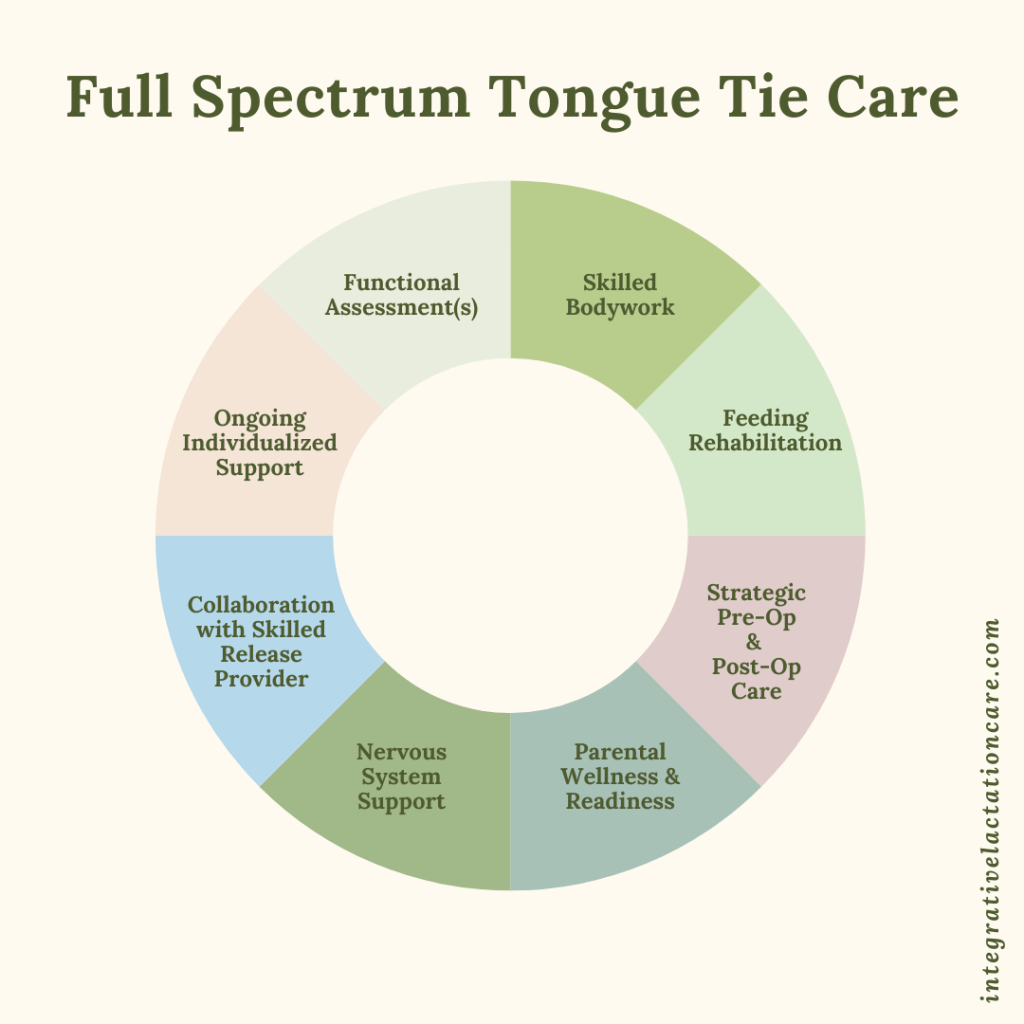
Full-spectrum tongue tie care looks like:
- starting with a comprehensive functional assessment from a function-savvy IBCLC
- seeing a skilled infant bodywork practitioner (pediatric PT, chiropractor, and/or craniosacral therapist) to address any ongoing tension or asymmetry in baby’s body
- working to optimize feeding, weight gain, & oral function pre-release
- supporting nervous system regulation in parent(s) & baby
- discussing expectations for the release, aftercare, & healing timeline prior to the release (and practicing stretches!)
- seeing a highly skilled & experienced release provider for effective & comfortable release
- working with function-savvy IBCLC on post-op rehabilitation
Full-spectrum tongue tie care is a unique specialization offered by Integrative Lactation Care that considers the whole family in creating an individualized plan for restoring optimal oral function.
If you’d like to book a functional evaluation, start here:
Frequently Asked Questions:
Q: Does this approach really lead to better outcomes?
A: Unequivocally, yes. While we don’t yet have specific data on the short- and long-term outcomes of infants who receive full-spectrum tongue tie care vs. rudimentary care, we DO have data on many of the individual components of this process for infants and adults, and can generalize that combining these elements make for better outcomes. And anecdotally, ILC has a very high parent satisfaction rate for tongue tie care.
PMID: 32462918; PMID: 39216880, PMID: 26595832, PMID:
Q: My pediatrician said they can just clip it in the office, and that aftercare isn’t necessary?
A: Scissor releases are almost always incomplete releases. They typically release the anterior portion of the tie, but not the posterior portion. Releasing both is essential for optimal oral function in most babies. While a small number of parents experience improvement from an anterior release alone, the majority will not see a full resolution of symptoms from this type of procedure. Pediatricians are also typically not skilled release providers. Aftercare for an incomplete release is less essential, due to the different nature of the wound – but is still ideal.
Q: What is a functional assessment? How is this different from what they did at the hospital?
A: A functional assessment is performed by a provider who has advanced training in biomechanics of feeding and is able to evaluate whether the baby is feeding effectively, or relying on compensations to eat. A functional assessment does more than just swipe under the tongue. It involves observe a feeding, evaluating the infant’s suck, discussing symptom history in detail, assessing the oral musculature & reflexes, assessing the mobility of the infant’s body, and providing the parent with an overall summary of how these elements are shaping the infant’s feeding efficacy. A functional assessment takes at least 10-15 minutes – usually longer.
Q: This sounds like a big investment of time and money – how much will it cost?
A: Addressing oral restrictions is an unforeseen hurdle for many families, especially first-time parents, and navigating the unexpected costs can be challenging. Insurance may cover some or all of your IBCLC care, and frequently covers bodywork and the release procedure as well. ILC also offers a package with discounted per-visit rates for parents whose insurance does not cover lactation support.
Full-spectrum care includes working with you and your unique circumstances to figure out the best possible outcome for your family within your unique resource constraints (time, money, energy, health insurance, etc).
However, it is helpful for many families to think of this care as an investment in your child’s long-term health & well-being. Strategic improvements to oral function for tied babies in infancy may prevent or reduce the incidence of speech disorders, feeding challenges, dental & orthodontic issues, and sleep-disordered breathing, all of which come with costs down the road.
Q: What if I don’t want to pursue a release?
A: Full-spectrum tongue tie care centers your goals. My job is to provide you with information and help you weigh risks & benefits of every part of the process, and to empower you – the parent – to decide what is right for your child. For some families, this includes a surgical release, and for others, it does not, and it instead looks like comprehensive management & support of baby’s feeding compensations through other means. It’s why a highly individualized care plan is a key piece of this approach.
Q: Does this have to be in-person, or can it be done virtually?
A: ILC has coached many parents through this process virtually, so it is not a requirement to be in person. That said, if you are local to southeast Michigan, it is helpful to do the initial consultation in person whenever possible, even if subsequent follow-ups are virtual.
If you’d like to book a functional evaluation (or simply ask questions), start here:

 Integrative Lactation Care